API Security Incidents Report: Lessons from Q4 2025 Breaches
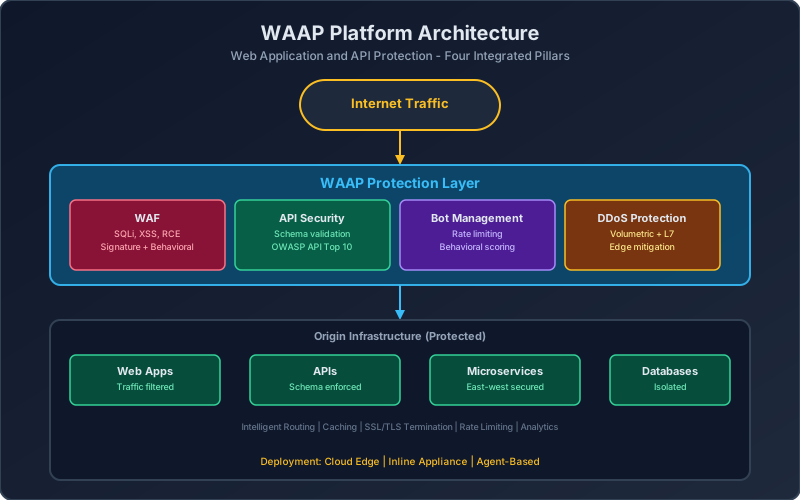
The fourth quarter of 2025 set a grim record: more API-related data breaches were reported in those three months than in any previous quarter. As we settle into 2026, it’s worth examining what went wrong — and how WAAP platforms could have prevented the most damaging incidents.
The Numbers Tell the Story
According to incident reports published in late December, Q4 2025 saw a 47% increase in API-related breaches compared to Q3. The average cost per incident rose to $4.8 million, driven largely by regulatory fines and remediation expenses.
Three patterns dominated the incident landscape:
1. Broken Object Level Authorization (BOLA)
BOLA was the root cause in 42% of all API breaches reported in Q4. The pattern is almost boring in its simplicity: an authenticated user changes an ID parameter and accesses another user’s data. A major healthcare provider exposed 3.7 million patient records when a mobile API endpoint failed to verify that the requesting user owned the medical record ID they requested.
The WAAP fix: API schema validation combined with context-aware authorization checks. A WAAP can’t fix broken application logic, but it can detect anomalous patterns — a single user accessing thousands of unique object IDs in rapid succession.
2. Shadow API Exploitation
A fintech startup exposed its entire customer transaction database through an undocumented GraphQL endpoint that had been deployed for internal testing six months prior. The endpoint had no authentication, no rate limiting, and no logging.
The WAAP fix: API discovery features in modern WAAP platforms automatically detect undocumented endpoints by analyzing traffic patterns. When a new API appears, the platform alerts the security team before it becomes a liability.
3. Excessive Data Exposure
An e-commerce platform’s order history API returned full credit card mask data (last four digits, expiration, card type) for every order. Developers had mapped the database schema directly to the API response without considering what the client actually needed.
The WAAP fix: Response inspection rules can flag and block API responses that contain sensitive data patterns (credit card numbers, SSNs, API keys) even when those responses are technically valid.
Key Takeaways for 2026
The Q4 2025 breach data makes one thing clear: API security isn’t a technology problem, it’s a fundamental process problem. The organizations that weathered Q4 without incident had three things in common:
- Complete API inventories with automated discovery
- Schema validation on every API endpoint
- Continuous monitoring with behavioral baselines
If you haven’t implemented all three, 2026 is the year to start.
For zero-trust API security architectures that complement your WAAP deployment, visit microsegmentation.uk. And for the latest on AI-powered threat detection, check out aisecurities.uk.
Want to go deeper? Check out these resources on Amazon:
As an Amazon Associate I earn from qualifying purchases.