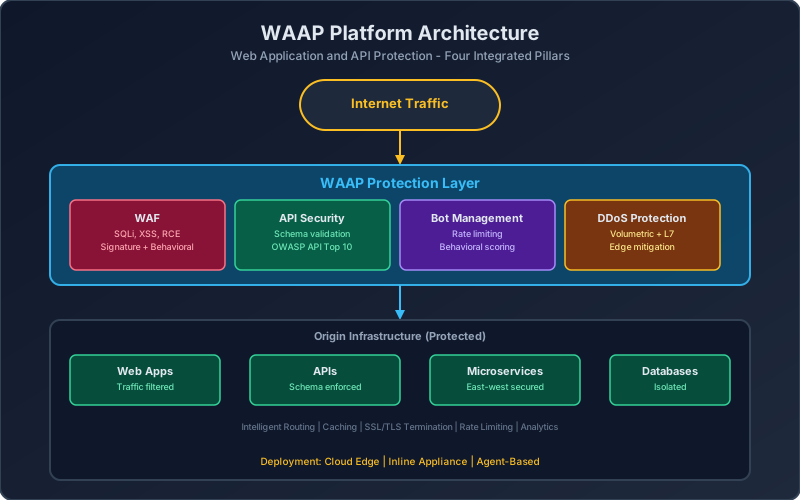
Banking Sector WAAP Requirements: Meeting Financial Regs in 2026
The banking sector has always been at the forefront of web security regulation, but 2026 brings a new wave of requirements that are reshaping how financial institutions deploy WAAP platforms. From updated PCI DSS v4.0.1 mandates to PSD3 in Europe and APRA’s enhanced cyber standards in Australia, the regulatory bar for web application and API protection has never been higher.
The New Regulatory Landscape
PCI DSS v4.0.1 — API-Specific Requirements
The latest PCI DSS update includes explicit requirements for API security that didn’t exist in previous versions. Specifically, Requirement 6.4 now mandates that all APIs processing cardholder data must have:
- Schema validation enforced at the network edge
- Automated discovery of all API endpoints quarterly
- Rate limiting on authentication endpoints
- Logging of all API access with user attribution
For banks that have been treating API security as a development-team responsibility, this is a wake-up call. API security is now an explicit compliance requirement, not just a best practice.
PSD3 — Strong Customer Authentication for APIs
The European Union’s PSD3, which took effect January 2026, extends Strong Customer Authentication (SCA) requirements to API-based payment initiation and account information services. This means WAAP deployments must be able to differentiate between SCA-compliant requests and non-compliant ones, enforcing different policies for each.
APRA CPS 234 — Continuous Assurance
Australia’s Prudential Regulation Authority now requires authorized deposit-taking institutions to demonstrate continuous effectiveness of their security controls, not just point-in-time compliance. For WAAP platforms, this means automated reporting, continuous rule validation, and real-time compliance dashboards are no longer optional.
WAAP Configuration for Banking Compliance
Logging and Auditing
Your WAAP must log every security decision with enough context for auditors: timestamp, source IP, user agent, request path, rule ID that triggered, and action taken. Log retention should meet regulatory requirements — typically 12 months for PCI DSS, 24 months for PSD3.
Automated Rule Deployment
Regulatory changes often require rapid rule updates. Ensure your WAAP supports automated, audited rule deployment pipelines. Manual rule changes introduce risk of human error and create audit gaps.
Segmentation of Sensitive Environments
Banking regulations increasingly require strict network segmentation between payment processing environments and general IT systems. Edge WAAPs alone cannot enforce this — you need internal segmentation as well.
The Bottom Line
Banking sector WAAP requirements in 2026 go beyond blocking attacks. Compliance now demands automated discovery, continuous validation, comprehensive logging, and demonstrable control effectiveness. WAAP is no longer just a security tool — it’s a compliance instrument.
For a deeper look at how microsegmentation supports banking network segmentation requirements, visit microsegmentation.uk. And for AI-driven compliance automation, check out aisecurities.uk.
Want to go deeper? Check out these resources on Amazon:
As an Amazon Associate I earn from qualifying purchases.