CVE-2026 Trends for Web Apps: What the First Quarter Reveals
The first two months of 2026 have already produced enough CVE data to identify clear trends in web application vulnerabilities. As of late February, 847 CVEs affecting web applications have been published — a 22% increase over the same period in 2025. The types of vulnerabilities being disclosed, the software categories affected, and the exploitation timelines all tell a story about where the web security landscape is heading.
Top CVE Categories for Q1 2026
1. Server-Side Request Forgery (SSRF) — Up 68%
SSRF vulnerabilities are the standout trend of early 2026. The increase is driven largely by the proliferation of AI-powered features that fetch external URLs — content summarizers, image generators, data enrichment pipelines. Every time an application makes an HTTP request to a user-supplied URL, SSRF is a possibility.
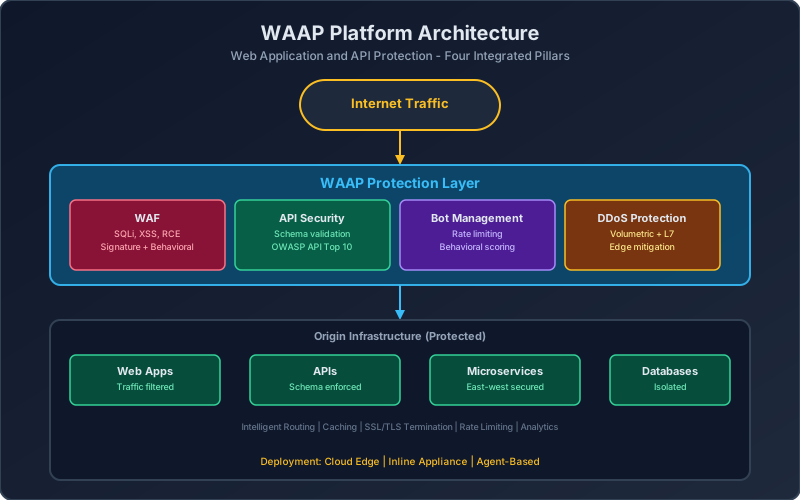
WAAP mitigation: Enable URL validation rules that restrict outbound requests to approved domains. Block requests to private IP ranges (10.0.0.0/8, 172.16.0.0/12, 192.168.0.0/16, 169.254.0.0/16) at the edge.
2. Prototype Pollution — Up 43%
Prototype pollution vulnerabilities in JavaScript applications continue to rise, particularly in server-side Node.js environments. Attackers exploit the ability to modify Object.prototype to inject properties that bypass security checks, modify application behavior, or achieve remote code execution.
WAAP mitigation: While WAAPs can’t fully prevent prototype pollution (it’s an application-layer issue), edge rules can detect and block requests containing suspicious __proto__, constructor.prototype, or mass assignment patterns.
3. Insecure Direct Object References (IDOR) — Up 31%
IDOR vulnerabilities — essentially the same as BOLA in API contexts — remain stubbornly common. The increase in Q1 2026 is attributed to the rapid deployment of AI-generated code that frequently omits authorization checks.
WAAP mitigation: Anomaly detection rules that flag unusual patterns of object ID access can identify IDOR exploitation attempts even when the underlying code is vulnerable.
Average Exploitation Timeline
The most concerning trend from Q1 2026 data is the shrinking window between CVE publication and active exploitation. The average time has dropped from 15 days in 2025 to just 8 days in early 2026. For critical severity CVEs, exploitation often begins within 48 hours of public disclosure.
The Bottom Line
The CVE landscape for web apps in 2026 is defined by three forces: AI-generated code introducing classic vulnerabilities at scale, SSRF from AI feature adoption, and faster-than-ever exploitation timelines. WAF rule sets must be updated within hours — not days — of CVE publication. Automated rule update pipelines are no longer a convenience; they’re a necessity.
For zero-trust architectures that limit blast radius when the next zero-day hits, visit microsegmentation.uk. And for real-time AI-powered CVE correlation, check out aisecurities.uk.
Want to go deeper? Check out these resources on Amazon:
As an Amazon Associate I earn from qualifying purchases.