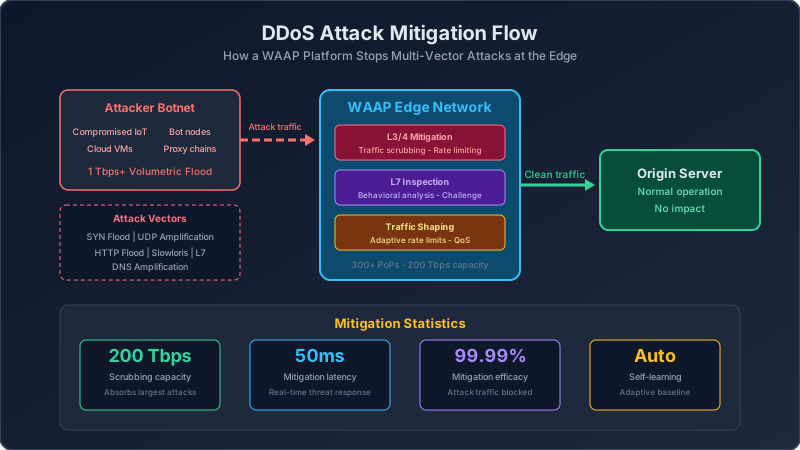
DDoS Attack Vector Evolution: What Changed in 2026
DDoS attacks have undergone a dramatic evolution in the past twelve months. While volumetric floods continue to grow in size, the most concerning development is the sophistication of application-layer attacks designed specifically to bypass WAAP defenses. Understanding these new vectors is essential for configuring effective protection.
The Three Shifts in DDoS Attack Patterns
1. HTTP/2 Rapid Reset Attacks
The HTTP/2 Rapid Reset vulnerability (CVE-2023-44487) continues to be exploited, but 2026 has seen weaponized implementations that specifically target WAAP appliances rather than origin servers. Attackers send streams that reset at precisely the rate that triggers maximum CPU usage on the WAAP’s connection management layer, degrading performance for all tenants on shared WAAP infrastructure.
Mitigation: Ensure your WAAP provider has patched against known Rapid Reset variants. Configure per-connection stream limits below provider defaults.
2. AI-Orchestrated Application-Layer Attacks
The most significant new vector in 2026 is the use of AI agents to orchestrate application-layer DDoS attacks. Rather than flooding with identical requests, AI-driven botnets distribute attacks across hundreds of endpoints, vary payload structures, and adapt to mitigation responses in real time.
Traditional rate limiting fails against these attacks because no single IP or endpoint receives enough traffic to trigger thresholds. The attack is distributed across the entire application surface.
Mitigation: Deploy behavioral anomaly detection that models normal traffic patterns at the session level, not just per-IP or per-endpoint.
3. DNS Water Torture Targeting WAAP Edge
Attackers have discovered that DNS infrastructure supporting WAAP edge networks can be saturated more cost-effectively than the HTTP layer itself. By flooding WAAP provider DNS resolvers with queries for random subdomains, attackers degrade name resolution for legitimate traffic before a single HTTP request reaches the edge.
Mitigation: Ensure your WAAP provider offers dedicated DNS protection or use a separate DNS-layer DDoS mitigation service.
Configuring WAAP for 2026 DDoS Threats
Baseline Behavioral Profiles
The most effective defense against AI-orchestrated DDoS is a well-established traffic baseline. Your WAAP needs at least 30 days of traffic data to build accurate profiles for your specific application. If you deployed a new WAAP recently, the first month of operation is your most vulnerable period.
Multi-Layer Rate Limiting
Single-layer rate limiting is no longer sufficient. Implement limits at three levels simultaneously:
- Per-IP — catches simple flood attacks
- Per-session — defeats IP rotation
- Per-application-flow — catches distributed application-layer attacks
Emergency Response Automation
Configure automated emergency responses that trigger when baseline deviation exceeds predefined thresholds. In 2026, the window between attack start and critical impact can be measured in seconds, not minutes. Manual response is too slow.
The Bottom Line
DDoS attacks in 2026 are smarter, more distributed, and more targeted at WAAP infrastructure itself. The era of simple volumetric attacks is giving way to AI-orchestrated, multi-vector campaigns that require layered, adaptive defenses. Your WAAP configuration must evolve at the same pace as the attacks it’s designed to stop.
For complementary on-premises DDoS protection strategies, visit microsegmentation.uk. And for AI-driven anomaly detection solutions, check out aisecurities.uk.
Want to go deeper? Check out these resources on Amazon:
As an Amazon Associate I earn from qualifying purchases.