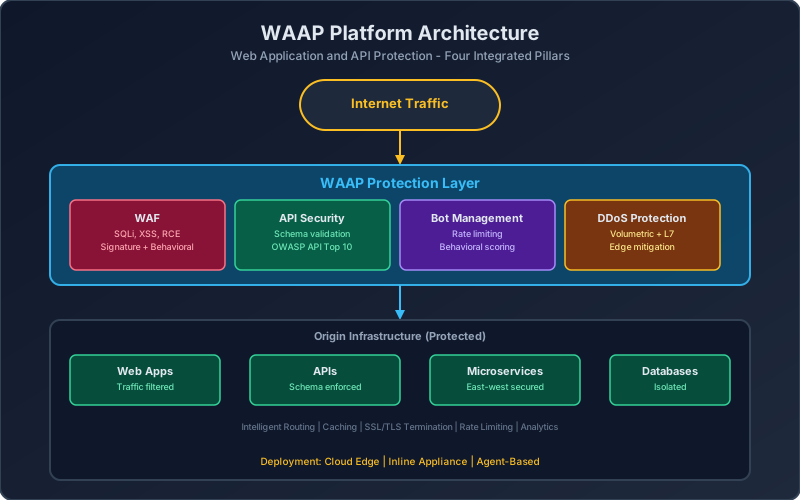
Financial Sector WAAP Deployments: Case Studies and Lessons
The financial sector has been one of the fastest adopters of WAAP technology, driven by both regulatory pressure and the direct financial impact of API breaches. Three recent case studies from Q1 2026 illustrate the challenges and successes of WAAP deployment in financial environments.
Case Study 1: Regional Bank — API Inventory Discovery
The challenge. A regional bank with $12 billion in assets discovered during a PCI DSS audit that they had over 400 API endpoints in production — more than double what their security team had documented. Shadow APIs included a deprecated mobile banking endpoint that still exposed full transaction histories without authentication.
The solution. Deploying a WAAP with automated API discovery capabilities. Within 48 hours of enabling discovery mode, the platform identified 237 undocumented endpoints. Each was classified by risk level based on data sensitivity and authentication requirements.
The result. The bank reduced its exposed API surface by 60% within two weeks. Deprecated endpoints were either secured with proper authentication or decommissioned. The WAAP now continuously monitors for new undocumented endpoints and alerts the security team within minutes of detection.
Case Study 2: Credit Card Processor — Rate Limiting
The challenge. A credit card processing platform faced daily credential stuffing attacks on their merchant login API. Attackers rotated through thousands of IP addresses to bypass standard rate limits, and the platform was experiencing account takeover incidents at a rate of 15-20 per week.
The solution. The team implemented layered rate limiting through their WAAP: per-merchant-ID limits at the application layer, per-session limits based on browser fingerprinting, and per-IP limits at the edge. Notably, they implemented cost-based rate limiting on the login endpoint — each login attempt was assigned a cost of 10 units, with a budget of 100 units per merchant per minute.
The result. Account takeover incidents dropped to zero within the first week. The layered approach caught attacks that single-layer rate limiting missed, and legitimate merchants experienced no friction because their traffic fell well within normal parameters.
Case Study 3: Investment Platform — GraphQL Security
The challenge. An investment management platform migrated from REST to GraphQL to support their mobile trading app. Post-migration, they experienced performance degradation under normal load and discovered that some clients were sending deeply nested queries that consumed disproportionate server resources.
The solution. The team implemented GraphQL query depth limiting (max 6 levels) and query cost analysis at the WAAP level. They also disabled introspection in production and switched to persistent queries for their mobile app clients.
The result. Server CPU usage dropped 40% after implementing query depth limits. The persistent queries eliminated introspection and aliasing attack vectors entirely.
Key Lessons
- Start with discovery. You cannot protect what you don’t know about
- Layer your rate limiting. Single-threshold approaches fail against modern attacks
- GraphQL needs GraphQL-aware security. Edge WAAP protection alone is insufficient
For zero-trust financial network segmentation architectures, visit microsegmentation.uk. And for AI-driven financial security automation, check out aisecurities.uk.
Want to go deeper? Check out these resources on Amazon:
As an Amazon Associate I earn from qualifying purchases.