GDPR and CCPA Compliance: How WAAP Fills the Gaps
Data privacy regulations continue to tighten across the globe. The GDPR has been followed by the European Data Protection Board’s new guidance on API data processing, and California’s CCPA has been amended to expand consumer rights for data accessed through APIs. For organizations subject to these regulations, WAAP platforms are emerging as essential compliance infrastructure — not just security tools.
The Privacy Regulation-API Security Connection
Modern applications expose customer data through dozens or hundreds of API endpoints. Every time an API returns personally identifiable information (PII), that data transfer falls under the jurisdiction of privacy regulations. The challenge is that most organizations don’t have full visibility into which APIs return PII and under what conditions.
GDPR Right of Access via APIs
The GDPR grants data subjects the right to access any personal data an organization holds about them. When that data is accessed through an API — as it increasingly is — regulators expect the same access controls, logging, and breach notification processes that apply to web interfaces.
Article 32 of the GDPR requires “appropriate technical measures” to protect personal data. The European Data Protection Board has explicitly stated that this includes API security controls, and several 2025 enforcement actions included fines specifically for inadequate API protection.
CCPA Amendments for API Data Access
California’s amended CCPA, effective January 2026, introduces new requirements for businesses that expose consumer data through APIs:
- Consumers must be notified when their data is accessed via API
- API access logs must be maintained for at least 24 months
- Consumers can request a list of all third parties that have accessed their data through APIs
- Businesses must implement “reasonable security measures” for all API endpoints
How WAAP Supports Privacy Compliance
Data Classification at the Edge
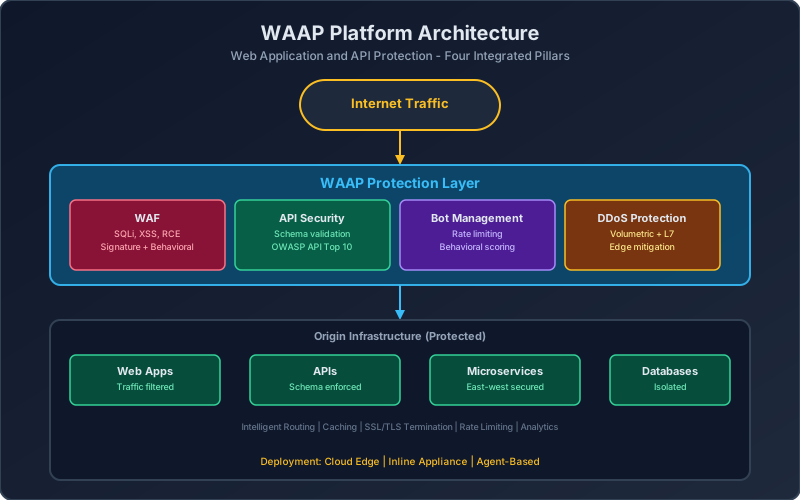
Modern WAAP platforms can inspect API response payloads and identify PII patterns — email addresses, phone numbers, credit card numbers, Social Security numbers, dates of birth. When PII is detected in an API response, the WAAP can log the event, alert the data protection team, or even block the response.
Access Logging and Auditing
WAAPs provide centralized logging of every API request and response, including geolocation of the requester, authentication method used, and data classification of the response. This creates the audit trail that regulators demand.
Consent-Based Policy Enforcement
Advanced WAAP configurations can enforce different policies based on consent status. If a user has withdrawn consent for data processing, the WAAP can block API requests that would return that user’s data, even if the application backend would have processed the request normally.
The Bottom Line
Privacy regulations and API security are converging. Organizations that treat WAAP as purely a security tool are missing half the value. A properly configured WAAP provides the data classification, access logging, and policy enforcement capabilities that GDPR and CCPA compliance demand.
For privacy-preserving microsegmentation architectures, visit microsegmentation.uk. And for AI-driven data classification automation, check out aisecurities.uk.
Want to go deeper? Check out these resources on Amazon:
As an Amazon Associate I earn from qualifying purchases.