GraphQL Attack Case Studies: Real Incidents from 2026
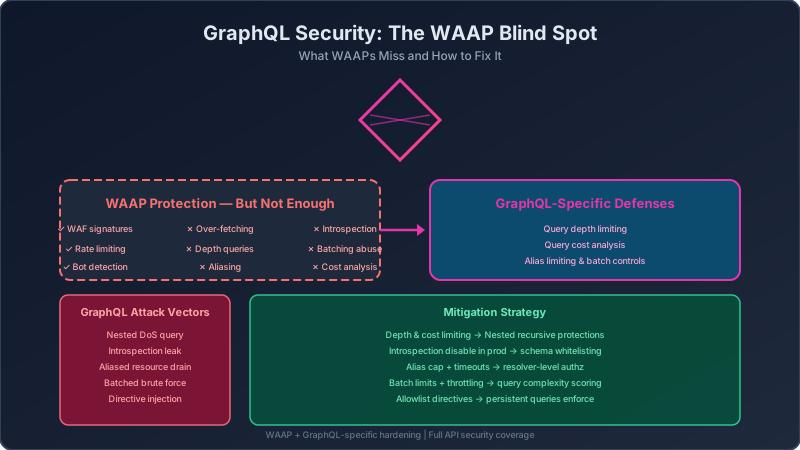
The first five months of 2026 have produced a series of significant GraphQL security incidents that offer important lessons for anyone running a GraphQL API. These are not theoretical attacks — they happened to real organizations, and the patterns they reveal are critical for WAAP configuration.
Case Study 1: E-Commerce Platform — Query Depth Denial of Service
The incident. A major e-commerce platform running GraphQL experienced a service outage that took their product catalog offline for four hours. The cause was a query depth attack: a single client sent a deeply nested query that traversed product → category → vendor → warehouse → supplier → pricing, six levels deep. At each level, the resolver made multiple database calls. A single query generated over 2,000 database queries.
The root cause. The platform had no query depth limiting configured. Their WAAP was deployed in front of the GraphQL endpoint, but it only inspected HTTP-level traffic, not the GraphQL query content.
The fix. Implemented query depth limiting (max 6 levels), query cost analysis (max 10,000 cost units per query), and per-session rate limiting based on aggregate query cost.
Lesson learned. Your WAAP cannot protect against GraphQL query-level attacks unless it includes GraphQL-aware inspection.
Case Study 2: SaaS Provider — Introspection Data Leak
The incident. A B2B SaaS provider discovered that a competitor had obtained their complete API schema — including internal types, deprecated fields, and admin-only mutations — through production schema introspection. The competitor used this data to build a competing integration months faster than they could have through API documentation alone.
The root cause. Introspection was enabled in production. The GraphQL endpoint had no IP allowlisting and no authentication on the /graphql route for schema queries.
The fix. Disabled introspection in production. Switched to persistent queries for all clients. Deployed the WAAP to detect and block __schema queries at the edge.
Lesson learned. Introspection is a development tool. It has no place in production. Blocking it at the WAAP level adds a valuable safety net.
Case Study 3: Fintech Startup — Batching Abuse
The incident. A financial services startup offering GraphQL-based transaction APIs fell victim to a credential stuffing attack that used batching mutations. The attacker sent batched login requests — 20 mutations per HTTP request — testing 5,000 credential combinations per second against the login endpoint.
The root cause. The WAAP was configured with per-request rate limiting (100 requests per second per IP) but had no limits on batch size or aggregate query cost.
The fix. Implemented per-batch mutation limits (max 3 mutations per batch), per-session rate limits based on total mutation count, and anomaly detection for unusual login patterns.
Lesson learned. Rate limiting at the HTTP level is meaningless against batched GraphQL attacks. Always enforce limits on aggregate query complexity, not just request count.
The Bottom Line
These case studies share a common theme: WAAP platforms that protect GraphQL APIs effectively must include GraphQL-aware inspection capabilities. Edge-level WAF protection is necessary but not sufficient. Query depth limits, introspection blocking, batch limits, and cost analysis must all be part of your WAAP configuration for GraphQL endpoints.
For zero-trust microsegmentation strategies that protect GraphQL microservices, visit microsegmentation.uk. And for AI-powered GraphQL threat detection, check out aisecurities.uk.
Want to go deeper? Check out these resources on Amazon:
As an Amazon Associate I earn from qualifying purchases.