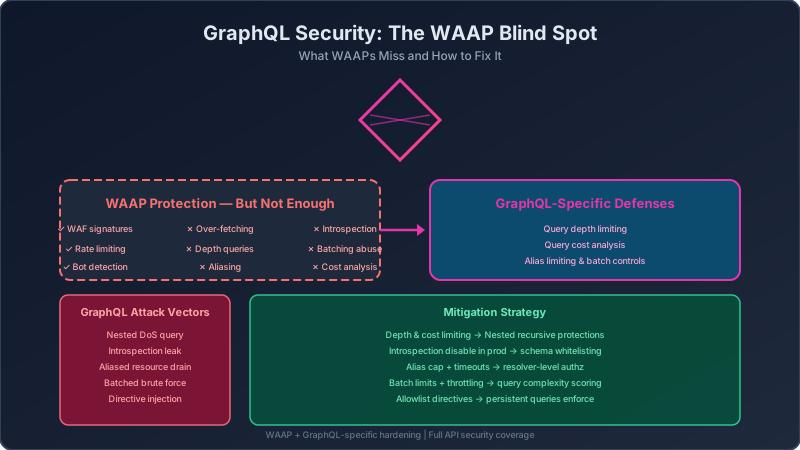
GraphQL Adoption Grows in Enterprises: Securing the New Standard
Enterprise adoption of GraphQL reached a tipping point in late 2025. Major financial institutions, healthcare providers, and government agencies have now deployed production GraphQL APIs, drawn by the flexibility and developer productivity gains the query language offers. But with rapid adoption comes a new wave of security challenges that traditional WAAP platforms struggle to address.
The Enterprise Shift to GraphQL
According to the 2025 State of API Security report, 62% of enterprises now run at least one production GraphQL API, up from 38% in 2024. The driving factors are clear: GraphQL reduces over-fetching, accelerates front-end development, and simplifies API versioning. For organizations managing dozens of microservices, a unified GraphQL gateway is transformative.
However, the security implications of this shift are not yet fully understood by most adopting organizations. GraphQL’s single-endpoint architecture fundamentally changes the attack surface in ways that signature-based WAF rules were never designed to handle.
Enterprise-Specific GraphQL Risks
Schema Leakage Through Introspection
Several major enterprises discovered in late 2025 that their production GraphQL endpoints had introspection enabled, exposing the complete API schema — including internal types, deprecated fields, and admin-only mutations — to anyone who queried for it. At least three Fortune 500 companies confirmed that attackers used introspection data to craft targeted attacks.
The fix is straightforward: disable introspection in production. Serve schema documentation through authenticated developer portals instead.
Query Depth Exploitation in Complex Enterprise Schemas
Enterprise GraphQL schemas are often significantly more complex than startup schemas, with dozens of interconnected types and deeply nested relationships. Attackers have exploited this complexity by crafting queries that drill through five or six levels of relations, triggering thousands of database calls from a single HTTP request.
Mitigation: Implement query depth limiting (max 5-7 levels) and query cost analysis that assigns weights to each field.
Batching Attacks on Authentication Endpoints
Enterprise login portals using GraphQL mutations for authentication are particularly vulnerable to credential stuffing via batched queries. Since a single HTTP request can contain dozens of mutations, attackers bypass per-request rate limits and test thousands of credentials per second.
The fix: Apply rate limits based on aggregate query cost, not just HTTP request count. Enforce strict batch size limits — no more than 3-5 mutations per batch.
Building a GraphQL Security Program
Enterprises adopting GraphQL need a layered security approach: edge WAAP protection for HTTP-level threats, GraphQL-aware middleware for query-level controls, and resolver-level authorization for data access control. All three layers must work together — no single layer is sufficient.
For deeper analysis of how microsegmentation protects east-west API traffic in GraphQL deployments, visit microsegmentation.uk. And for AI-assisted API security monitoring, check out aisecurities.uk.
Want to go deeper? Check out these resources on Amazon:
As an Amazon Associate I earn from qualifying purchases.