Healthcare API Compliance: HIPAA and WAAP in 2026
Healthcare organizations face a unique challenge in API security: they must protect electronic protected health information (ePHI) according to HIPAA requirements while enabling the interoperability that modern healthcare demands. The new HIPAA API security guidelines, effective June 2026, add specific requirements for API security controls that WAAP platforms are uniquely positioned to fulfill.
HIPAA and APIs: The New Reality
The HIPAA Security Rule has always required covered entities to implement “reasonable and appropriate” administrative, physical, and technical safeguards. But the 2026 update makes explicit what was previously implicit: APIs that access, transmit, or process ePHI must have specific security controls in place.
New HIPAA API Requirements
Effective June 2026, the following controls are required for any API handling ePHI:
- API authentication. Every API request accessing ePHI must be authenticated. Anonymous access is prohibited.
- Access logging. All API requests must be logged with user ID, timestamp, endpoint, data accessed, and response status. Logs must be retained for six years.
- Encryption in transit. All API traffic must use TLS 1.2 or higher. Mutual TLS is recommended for machine-to-machine communication.
- Rate limiting. Authentication endpoints must implement rate limiting to prevent brute force attacks.
- API inventory. Covered entities must maintain a complete inventory of all APIs handling ePHI, updated quarterly.
- Breach notification. Any API data breach involving ePHI must be detected and reported within 60 days.
How WAAP Supports HIPAA Compliance
API Discovery and Inventory
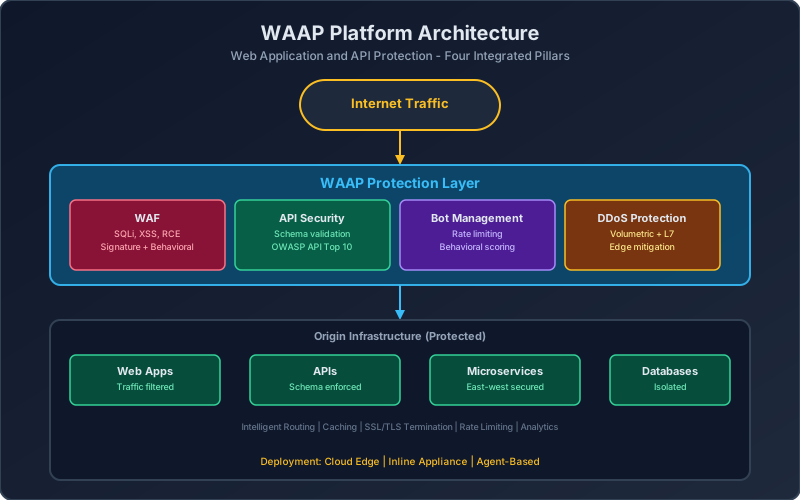
WAAP platforms with continuous API discovery automatically maintain the inventory that HIPAA now requires. When a new API endpoint appears — whether deployed by the development team or created by a third-party integration — the WAAP detects it, classifies its data sensitivity, and alerts the security team.
Access Logging and Auditing
Centralized WAAP logging provides the audit trail HIPAA demands. Every API request is logged with the required context, and logs can be exported to SIEM systems for long-term retention. Automated alerts can be configured for suspicious access patterns.
ePHI Detection in Transit
Advanced WAAP platforms can inspect API request and response payloads for ePHI patterns: patient identifiers, medical record numbers, diagnosis codes, and treatment information. When ePHI is detected in an API response, the WAAP can log the event for compliance reporting.
Breach Detection
Behavioral anomaly detection in WAAP platforms identifies potential breaches in real time — unusual data volumes, unexpected access patterns, or authentication failures — supporting the HIPAA requirement for timely breach detection.
The Bottom Line
The 2026 HIPAA API security update represents a significant shift for healthcare organizations. What was previously recommended is now required. WAAP platforms that combine API discovery, access logging, payload inspection, and anomaly detection provide a comprehensive compliance solution for healthcare APIs.
For healthcare network segmentation architectures that complement WAAP compliance, visit microsegmentation.uk. And for AI-powered HIPAA compliance automation, check out aisecurities.uk.
Want to go deeper? Check out these resources on Amazon:
As an Amazon Associate I earn from qualifying purchases.