OWASP API Top 10 Updates: What Changed and How to Respond
The OWASP API Security Project released its latest Top 10 list this month, and the changes reflect how the API threat landscape has evolved over the past two years. While some entries remain from previous editions, the reshuffling — and the addition of new categories — demands attention from every security team managing API workloads.
What’s New in the 2026 OWASP API Top 10
API1: Broken Object Level Authorization (BOLA) — Still #1
No surprise here. BOLA remains the most common and most dangerous API vulnerability. If anything, its prevalence has grown as more applications adopt microservices architectures where authorization checks are inconsistently applied across service boundaries.
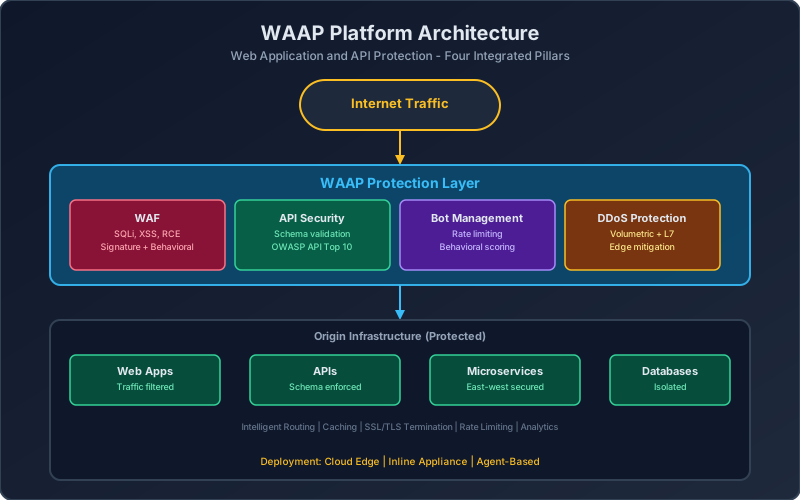
What changed: The guidance now emphasizes the need for authorization checks at every API gateway, not just at the application layer. WAAP platforms with API schema validation can enforce authorization patterns at the edge.
Moving Up: API3: Excessive Data Exposure
This vulnerability moved up two positions from 2024. The OWASP team notes that generative AI coding assistants have inadvertently worsened this problem — AI-generated API endpoints often return complete database objects rather than client-specific views.
Mitigation: Implement response filtering in your WAAP to strip sensitive fields from API responses automatically.
New Entry: API7: API Sprawl and Shadow APIs
For the first time, OWASP includes a category specifically for the risks posed by undocumented, unmanaged, and forgotten API endpoints. As organizations scale, shadow APIs proliferate — and attackers are actively scanning for them.
Mitigation: Deploy API discovery tools that continuously monitor traffic to identify unknown endpoints.
New Entry: API9: GraphQL-Specific Attacks
GraphQL query complexity attacks, batching abuse, and introspection leaks now have their own category. This reflects GraphQL’s mainstream adoption in enterprise environments.
Implementing the OWASP API Top 10 in WAAP Configurations
Your WAAP platform can address most of the OWASP API Top 10 categories directly:
- BOLA (API1): Enable anomaly detection for unusual object ID access patterns
- Broken Authentication (API2): Enforce OAuth 2.0 validation at the edge
- Excessive Data Exposure (API3): Configure response inspection rules
- Rate Limiting (API4): Implement granular, per-endpoint rate limits
- Shadow APIs (API7): Enable continuous API discovery
The remaining categories — particularly authorization issues and business logic flaws — require application-layer controls that complement your WAAP.
The Bottom Line
The OWASP API Top 10 updates confirm what security practitioners have been saying: API threats are evolving faster than most defenses. Use the updated list as a roadmap for your 2026 WAAP configuration priorities.
For zero-trust API segmentation strategies that close the gaps WAAPs can’t reach, visit microsegmentation.uk. And for the latest AI-driven API threat detection, check out aisecurities.uk.
Want to go deeper? Check out these resources on Amazon:
As an Amazon Associate I earn from qualifying purchases.