Serverless API Security: Protecting Functions at the Edge
Serverless architectures have become the default deployment model for new API workloads. AWS Lambda, Cloudflare Workers, and Azure Functions handle billions of invocations daily, powering everything from authentication flows to payment processing. But the security model for serverless APIs is fundamentally different from traditional containerized or VM-based deployments — and many WAAP configurations haven’t caught up.
Why Serverless Changes the Security Calculus
Ephemeral Execution Environments
Serverless functions spin up per-request and are destroyed milliseconds after completion. This makes traditional host-based security controls — intrusion detection agents, file integrity monitoring, antivirus — completely irrelevant. There’s nothing persistent to monitor. All security must be applied at the request level, before the function executes.
Identity-Based Networking
Serverless functions don’t have static IP addresses. They scale across hundreds of available IPs within a cloud provider’s range. IP-based WAF rules are largely ineffective for serverless workloads. Security decisions must be based on identity and request content, not network origin.
Cold Start Constraints
Every millisecond of request processing adds latency to serverless functions — and every millisecond costs money. Heavy WAF inspection at the function level degrades performance and increases costs. The ideal model is lightweight edge inspection with deep inspection reserved for high-risk requests.
Configuring WAAP for Serverless APIs
Deploy at the API Gateway Layer
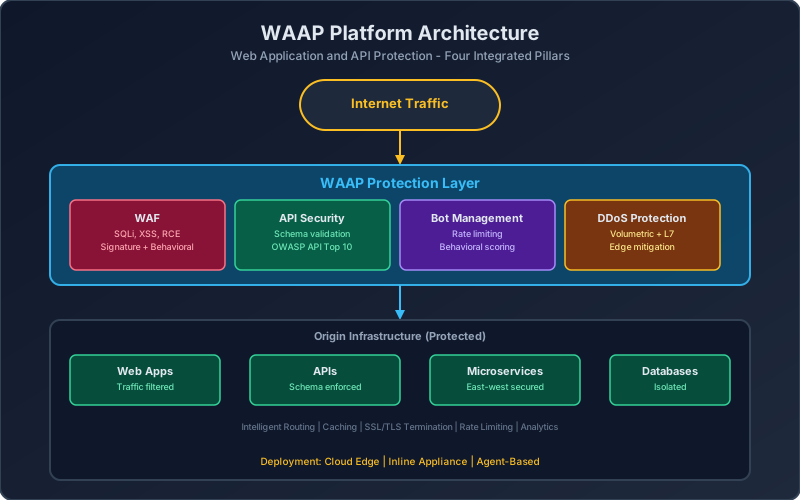
For serverless APIs, the WAAP should be deployed at the API gateway, not inline before the function. Major cloud providers offer integrated WAAP capabilities at their API Gateway layer: AWS WAF integrated with API Gateway, Cloudflare WAAP proxying Workers, Azure Front Door with Web Application Firewall.
This placement allows inspection before the request reaches the function while keeping latency overhead to a single digit milliseconds.
Schema Validation at the Edge
Serverless functions are often developed by different teams with varying security maturity. Enforcing OpenAPI schema validation at the WAAP level ensures that malformed requests are rejected before they trigger a function invocation — saving both security risk and compute cost.
Granular Rate Limiting Per Function
Different functions have different rate limit requirements. A user-search function might handle 1,000 requests per second. A password-reset function should never exceed 10 per second. Configure per-function rate limits at the WAAP level, tied to the specific API Gateway route.
The Bottom Line
Serverless doesn’t mean securityless. The principles remain the same — validate input, authenticate callers, authorize actions, limit rates — but the implementation must adapt to ephemeral, identity-based, latency-sensitive architectures. A WAAP deployed at the API gateway layer provides the protection serverless APIs need without the overhead they can’t afford.
For deeper insights into microsegmentation within serverless environments, visit microsegmentation.uk. And for AI-powered serverless security automation, check out aisecurities.uk.
Want to go deeper? Check out these resources on Amazon:
As an Amazon Associate I earn from qualifying purchases.