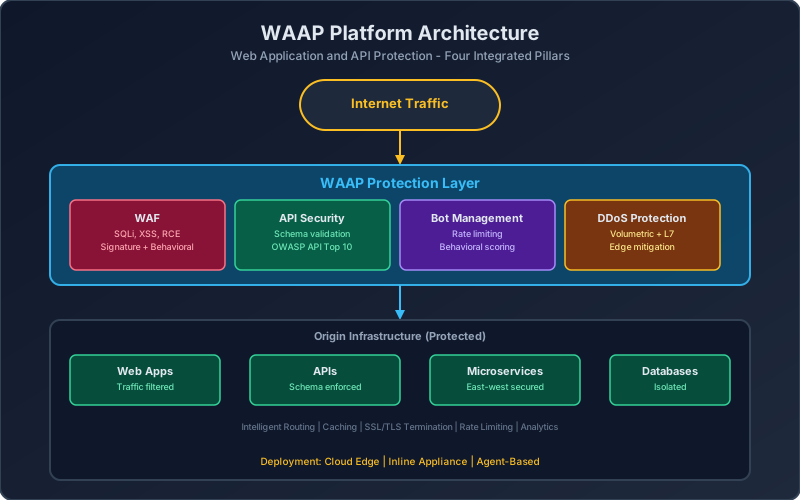
WebSocket Security: Protecting Real-Time Connections with WAAP
Real-time web applications are no longer a niche. From collaborative editing tools and live dashboards to financial trading platforms and multiplayer gaming, WebSocket connections now handle a significant portion of internet traffic. Yet WebSocket security remains a blind spot in many WAAP deployments — and attackers are starting to exploit it.
Why WebSockets Are Different
WebSocket connections start as standard HTTP upgrades but then switch to a persistent, bidirectional protocol that operates over a single TCP connection. After the upgrade handshake, there are no HTTP headers, no request paths, no HTTP methods — just raw data frames.
This creates several security challenges for traditional WAAPs:
- No per-frame inspection. Once the WebSocket connection is established, most WAAPs treat the data stream as opaque binary. They can’t inspect individual messages for SQL injection, XSS, or other attack payloads.
- No per-message rate limiting. Rate limits are applied at connection time (X connections per second from a single IP), but there’s no mechanism to limit messages per second over an established connection.
- Extended session windows. A WebSocket connection can remain open for hours or days. An attacker who compromises a client device can use an open WebSocket to exfiltrate data, issue commands, or maintain persistence without triggering any new connection alerts.
Real-World WebSocket Attacks in 2026
Data Exfiltration Over WebSocket
Attackers have been observed using WebSocket connections to exfiltrate data from compromised applications. Because WebSocket traffic often bypasses standard HTTP inspection and logging, exfiltration can continue for days without detection.
WebSocket Injection
When applications construct WebSocket messages from user input without sanitization, attackers can inject malicious messages that are then processed by other connected clients or server-side handlers. This is effectively stored XSS over WebSocket, and most WAAPs don’t detect it.
WebSocket Hijacking
Cross-Site WebSocket Hijacking (CSWSH) exploits the same-origin policy gap in WebSocket connections. An attacker’s website initiates a WebSocket connection to a target application using the victim’s existing session cookies, then reads responses or sends commands as the victim.
Securing WebSockets with WAAP
Connection Validation
Validate WebSocket upgrade requests as strictly as any other HTTP request. Verify the Origin header matches your application domain. Require CSRF tokens in the upgrade request. Enable session binding so the WebSocket connection is tied to the authenticated session.
Message Inspection
Some WAAP platforms now support WebSocket message inspection using custom rules. If your WAAP supports it, configure rules to inspect message payloads for common attack signatures. At minimum, log message metadata (frequency, size, type) for anomaly detection.
Disconnect Policies
Configure maximum connection duration and idle timeout policies. A WebSocket connection that stays open for more than 24 hours should be terminated regardless of activity level. An idle connection with no messages for 30 minutes should be disconnected.
The Bottom Line
WebSockets aren’t going away — real-time applications are becoming the norm. The security industry is still catching up, but forward-looking teams are already implementing WebSocket-specific controls in their WAAP configurations. If your application uses WebSockets, verify that your WAAP provides the inspection, logging, and policy controls needed to secure them effectively.
For zero-trust architectures that segment WebSocket traffic at the network layer, visit microsegmentation.uk. And for AI-powered real-time threat detection, check out aisecurities.uk.
Want to go deeper? Check out these resources on Amazon:
As an Amazon Associate I earn from qualifying purchases.