WAAP vs Next-Gen WAF: What's the Difference in 2026?
If you’ve been in web security for more than a year, you’ve heard of WAFs — Web Application Firewalls. But in 2026, WAF alone isn’t enough. Enter WAAP: Web Application and API Protection. It’s the evolution of web security for a world where APIs outnumber web pages. But what exactly distinguishes a WAAP from a next-generation WAF? The lines have blurred, but important differences remain.
From WAF to WAAP
A traditional WAF inspects HTTP traffic and blocks common web attacks — SQL injection, cross-site scripting, file inclusion. It operates on known attack signatures and, in more advanced implementations, on behavioral rules. For the past two decades, this has been the standard for protecting web applications.
Next-generation WAFs added machine learning detection, API discovery, and bot management — features that start to look a lot like WAAP capabilities. So what’s actually different?
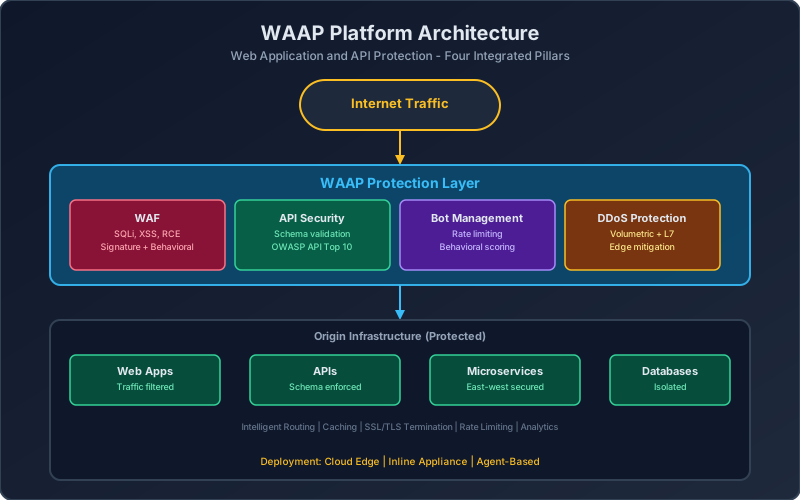
The Four Pillars of WAAP
True WAAP platforms combine four capabilities into a single, integrated solution:
- WAF — traditional web application firewall protection
- API security — API-specific threat detection, schema validation, and discovery
- Bot management — distinguishing human traffic from automated clients
- DDoS protection — defending against volumetric and application-layer attacks
Many next-gen WAFs offer subsets of these four pillars. A WAAP must offer all four with deep integration between them.
Key Differentiators
The practical differences between WAAP and next-gen WAF come down to:
- API schema validation. A WAAP enforces OpenAPI/Swagger specs at the edge. A next-gen WAF may inspect API traffic but won’t validate against a schema.
- Unified bot scoring. WAAP provides a single bot confidence score per session that all four modules share. Next-gen WAFs typically run bot detection as a separate module.
- API discovery. WAAP platforms include automated API discovery as a core feature. Next-gen WAFs may offer it as an add-on.
- Positive security model. WAAP platforms default to allowing only known-good traffic. WAFs default to blocking known-bad traffic.
Which One Do You Need?
Choose a next-gen WAF if: You’re protecting traditional web applications with minimal API exposure. Your bot management needs are basic. You have a small team that can manage separate security tools.
Choose a WAAP if: Your application is API-first or API-heavy. You need automated API discovery. Bot management is a significant concern. You want a unified security platform rather than point solutions.
The Bottom Line
If all you’re protecting is a few traditional web pages, a next-gen WAF still serves. But if you’re running modern applications with APIs, microservices, and mobile clients, WAAP isn’t optional. It’s the minimum viable protection for today’s threat landscape. The question isn’t whether to adopt WAAP — it’s which platform and how fast you can implement it.
For zero-trust architectures that complement your WAAP deployment, visit microsegmentation.uk. And for the latest in AI-powered security automation, check out aisecurities.uk.
Want to go deeper? Check out these resources on Amazon:
As an Amazon Associate I earn from qualifying purchases.